1. The Blue Whale of Catoosa (Catoosa, Oklahoma)
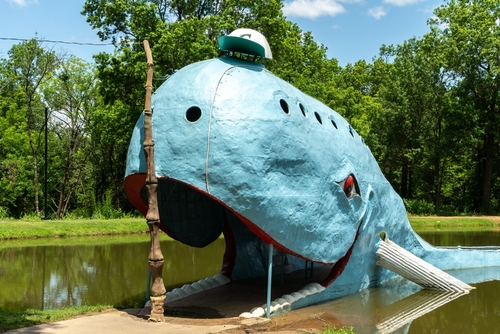
Just off old Route 66 outside Tulsa sits a giant blue whale rising out of a small pond. The structure was built in the early 1970s by Hugh Davis as an anniversary gift for his wife, who collected whale figurines. Over time he expanded the pond and added a picnic area, turning the quirky sculpture into a community gathering spot. Families would swim and relax around the whale during Oklahoma’s hot summers.
Even after the swimming stopped, the whale remained one of Route 66’s most beloved roadside icons. Travelers stop to walk across the whale’s back and snap photos beside its cheerful smile. The attraction captures the playful creativity that flourished along America’s most famous highway. It also reflects how many roadside landmarks began as personal projects that grew into cultural symbols.
2. Cadillac Ranch (Amarillo, Texas)
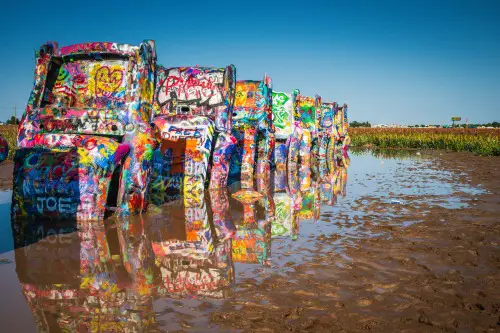
If you’ve ever driven along Interstate 40 outside Amarillo, you’ve probably spotted a row of half-buried Cadillacs nose-down in a dusty field. Cadillac Ranch was installed in 1974 by the San Francisco art collective Ant Farm and funded by local helium millionaire Stanley Marsh 3. The artists buried ten Cadillacs with their tailfins sticking up, each model dating from 1949 through 1963. Their tilt even mirrors the angle of the Great Pyramid of Giza.
What makes the stop special is that visitors are encouraged to interact with it. Travelers bring cans of spray paint and add their own marks to the cars, which means the installation is constantly changing. Layers of graffiti build up so thickly that pieces occasionally break off and reveal older paint beneath. It’s a perfect example of how roadside attractions became participatory landmarks during the golden age of American road trips.
3. Wall Drug (Wall, South Dakota)
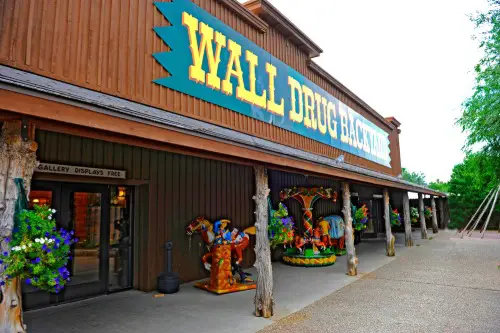
Driving across western South Dakota, you’ll start seeing signs for Wall Drug hundreds of miles before you actually reach it. The pharmacy opened in 1931, but it struggled until the owners began offering free ice water to travelers during a brutally hot summer in 1936. They promoted the offer with roadside billboards along the highway, and the idea worked almost instantly. Soon motorists were pulling off the road in droves.
Today Wall Drug has grown into an entire western-themed complex that fills most of a city block. Inside you’ll find restaurants, souvenir shops, and the original drugstore counter where travelers still sit for coffee and donuts. The place feels like a time capsule from the mid-20th-century highway era. Its endless billboards also helped define how roadside advertising shaped the American travel experience.
4. Wigwam Motel (Holbrook, Arizona)
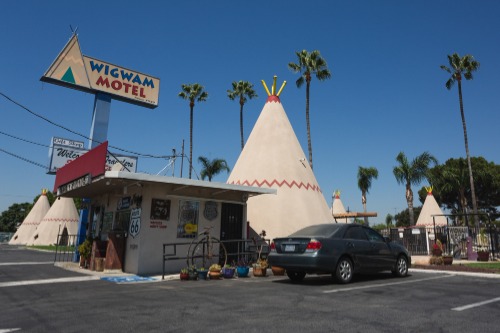
Pulling into the Wigwam Motel in Holbrook feels a bit like stepping into a cartoon version of the American Southwest. The motel opened in 1950 as part of a small chain built around novelty architecture. Instead of typical rooms, guests stay inside concrete teepee-shaped structures arranged around a central parking area. Each “wigwam” stands about 32 feet tall.
The motel was designed to catch the eye of drivers cruising along Route 66. Bright neon signs and unusual shapes helped roadside businesses compete for attention in the early days of automobile tourism. Today the motel still operates, making it one of the few surviving examples of this style. Staying the night offers a rare chance to experience a genuine mid-century road trip stop.
5. The Corn Palace (Mitchell, South Dakota)

At first glance the Corn Palace looks like a colorful palace rising out of the prairie. The building dates back to the late 1800s when local boosters wanted to show off South Dakota’s agricultural success. Each year artists create giant murals on the exterior using thousands of ears of corn and other grains. The colors come from naturally different varieties of corn.
The murals are completely redesigned every year, which means no two visits look exactly the same. Inside, the building functions as a community arena for sports, concerts, and festivals. Travelers stop both for the oddity and the craftsmanship behind the decorations. It tells the story of how roadside attractions often grew from local pride and small-town promotion.
6. South of the Border (Hamer, South Carolina)
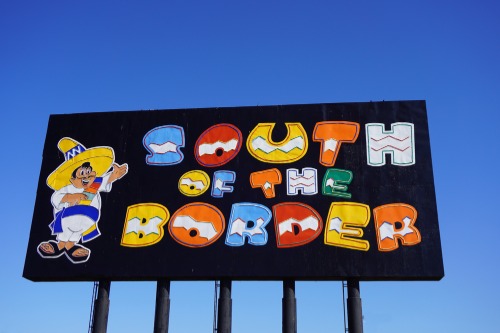
If you’re driving along Interstate 95 through the Carolinas, the billboards for South of the Border begin appearing long before you arrive. The roadside complex opened in 1949 just south of the North Carolina line. Its founder, Alan Schafer, built it to attract travelers who had to stop when crossing the state border for beer and food due to liquor laws at the time. The site grew into a sprawling tourist stop with restaurants, shops, and a small amusement park.
A giant sombrero-shaped observation tower now dominates the skyline. The kitschy humor and endless signage reflect a particular style of mid-century roadside marketing. For decades it served as a recognizable landmark for East Coast road trippers heading to Florida. Love it or hate it, the place illustrates how highways created entire mini-destinations designed purely for passing motorists.
7. The World’s Largest Ball of Twine (Cawker City, Kansas)
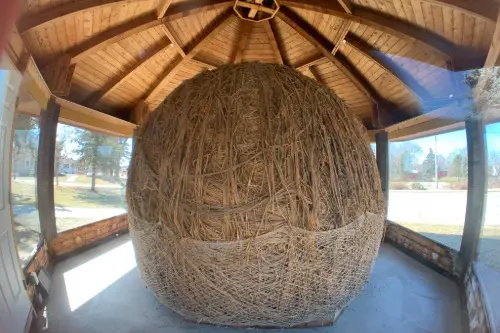
In the small town of Cawker City you’ll find a massive ball of twine sitting under an open-sided shelter. It began in 1953 when farmer Frank Stoeber started winding bits of sisal twine together during his spare time. By the time he stopped working on it in 1974, the ball weighed several tons. Locals decided to keep the tradition alive after his death.
Every August the town hosts a Twine-a-thon where visitors add new strands to the growing ball. That means the attraction is literally still expanding year after year. Road trippers often detour across Kansas just to see it and contribute a piece. It represents the uniquely American fascination with quirky “world’s largest” roadside records.
8. Salvation Mountain (Niland, California)
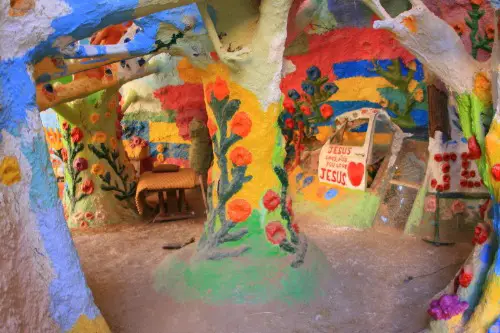
Near the eastern edge of California’s Salton Sea stands a colorful hill covered entirely in painted biblical messages. Salvation Mountain was created by Leonard Knight, who spent decades building and repainting the structure by hand starting in the 1980s. The mound is made largely from adobe, straw, and thousands of gallons of paint. Bright stripes, flowers, and giant lettering cover nearly every surface.
Travelers driving through the desert often stop simply because the sight is so unexpected. The mountain eventually became a recognized folk art landmark and was preserved with help from volunteers. Visitors can walk around the base and explore nearby painted installations. It tells a story about individual vision and how unconventional roadside art can become part of the travel landscape.
9. Carhenge (Alliance, Nebraska)
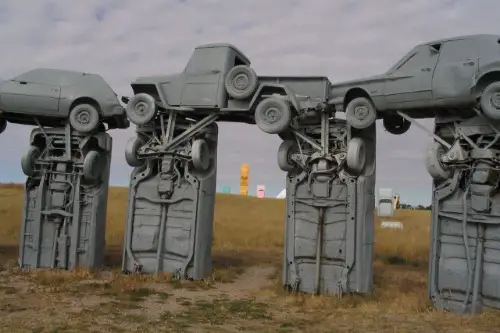
In the plains of western Nebraska you might suddenly spot something that looks suspiciously like England’s Stonehenge. Carhenge was built in 1987 by artist Jim Reinders using 39 vintage American automobiles. The cars are arranged in the same pattern and proportions as the ancient stone monument. Many of them are painted gray to mimic weathered stone.
Reinders created the sculpture as a memorial to his father, and friends helped place the vehicles upright in the field. What started as a temporary tribute quickly became a popular roadside curiosity. Visitors now walk through the circle and explore nearby car-themed sculptures. The attraction reflects the playful spirit that often defines American roadside art.
10. Lucy the Elephant (Margate City, New Jersey)

Standing six stories tall near the Jersey Shore, Lucy the Elephant has been watching over the coastline since 1881. The wooden elephant-shaped building was originally constructed by real estate developer James V. Lafferty. He hoped the unusual structure would attract potential buyers to the surrounding land. Visitors could climb inside and look out from a viewing platform on Lucy’s back.
Over the decades Lucy served as everything from a tavern to a summer cottage. By the 1960s the structure had fallen into serious disrepair and was nearly demolished. A local preservation group saved and restored it, reopening the landmark to the public in 1976. Lucy now stands as one of the oldest surviving roadside attractions in the United States.
11. The Big Texan Steak Ranch (Amarillo, Texas)

Just off Interstate 40 in Amarillo sits a bright western-style restaurant famous for a very specific challenge. Since 1962 the Big Texan Steak Ranch has offered a free 72-ounce steak dinner to anyone who can finish it in under an hour. The meal also includes shrimp cocktail, a baked potato, salad, and a roll. Contestants eat at a raised table so the entire dining room can watch.
The spectacle turns dinner into roadside entertainment. Thousands of travelers attempt the challenge every year, though only a fraction succeed. The restaurant itself looks like an Old West movie set, complete with wagon décor and neon lights. Stops like this show how highway culture blended food, spectacle, and storytelling into memorable travel traditions.
This post Roadside Stops That Tell the Story of American Travel was first published on American Charm.