
1. AOL
The sound of a dial-up modem and the phrase “You’ve got mail!” defined the early internet. AOL brought millions of Americans online for the first time, bundling access, chat rooms, and email into one neat package. But as broadband replaced dial-up, AOL’s business model collapsed. The company tried pivoting into media, buying brands like Huffington Post, but never fully recovered.
AOL was eventually acquired by Verizon in 2015 and quietly faded into corporate obscurity. Today, it’s a relic of how early internet access worked—and how fast things can change. For many, though, AOL was their first online experience. It represents a moment when the web still felt like a frontier.
2. MySpace
Before Facebook ruled social media, MySpace was the place to hang out online. Launched in 2003, it let users customize pages, share music, and rank their “Top 8” friends—a mix of innovation and digital drama. By 2005, News Corp. bought it for $580 million, believing it would dominate the social web for years. But Facebook’s cleaner interface and privacy controls pulled users away fast.
By 2011, MySpace had lost almost all its relevance, pivoting to a music-sharing platform before fading further. The site still exists, but few remember to visit. Ironically, many of today’s influencers and tech founders started there, learning early lessons about online presence. MySpace’s fall was proof that in tech, being first doesn’t mean staying first.
3. RadioShack
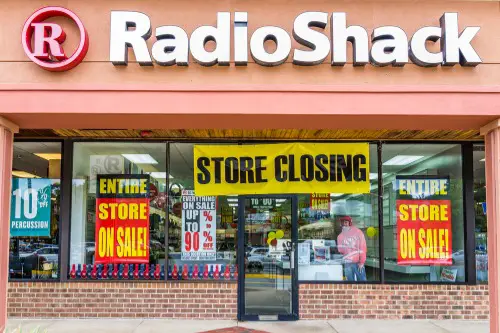
For decades, RadioShack was where tech lovers and hobbyists went to tinker. It sold everything from resistors and RC cars to early computers, serving as a gateway to the digital age. In the 1980s, it was a household name with thousands of stores and even its own computer line, the TRS-80. But as big-box retailers and online stores took over, its niche appeal couldn’t sustain it.
The company filed for bankruptcy twice—in 2015 and 2017—and closed nearly all of its locations. A few independent stores still exist under the name, but it’s mostly an online brand now. Many who grew up before Amazon remember it fondly as a place where curiosity met convenience. RadioShack’s story is one of how quickly innovation can outpace the innovators.
4. Toys “R” Us
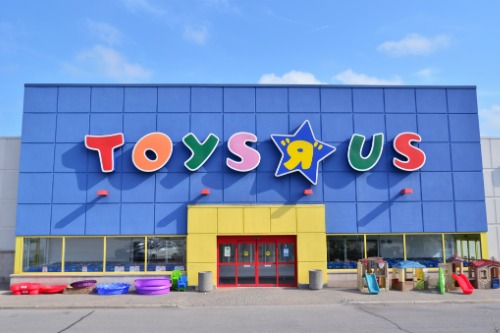
Few jingles are as nostalgic as “I don’t wanna grow up, I’m a Toys ‘R’ Us kid.” The toy store chain dominated childhoods for decades, creating a wonderland of shelves packed with everything kids could imagine. But by the 2010s, online shopping and crushing debt from a leveraged buyout spelled its end. The company filed for bankruptcy in 2017, closing hundreds of stores across the U.S.
Although the brand has tried several comebacks—most recently opening small-format stores through Macy’s—it’s never recaptured its old magic. For millennials, seeing Toys “R” Us vanish felt like losing a piece of youth itself. Geoffrey the Giraffe may still appear here and there, but the empire is gone. It’s a reminder that even childhood icons aren’t immune to market forces.
5. Circuit City
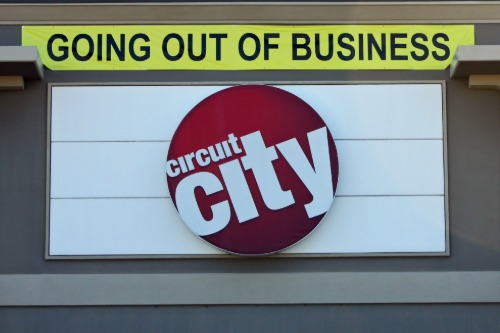
Before Best Buy became the go-to electronics retailer, there was Circuit City. Founded in 1949, it grew into a massive chain selling TVs, stereos, and computers at the height of the home electronics boom. But internal mismanagement and the rise of online competition caught up to it fast. The company filed for bankruptcy in 2008, closing all of its stores soon after.
It briefly reappeared as an online-only brand in 2016, but never regained traction. Circuit City’s downfall is often cited as a textbook example of poor leadership decisions—like firing its highest-paid salespeople in a misguided cost-cutting move. In hindsight, those employees were part of what made the brand stand out. Without them, Circuit City lost its human touch and, eventually, its customers.
6. Borders
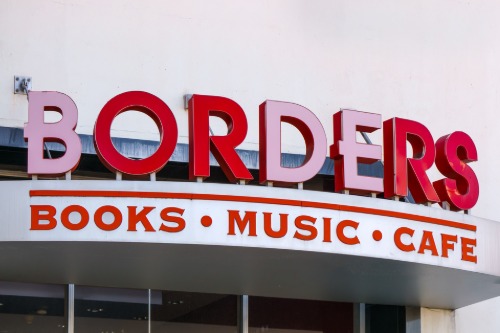
In the era before e-books, Borders was the cozy alternative to Barnes & Noble. It offered rows of books, in-store cafés, and even music sections where you could sample CDs. But while Barnes & Noble invested early in online sales, Borders outsourced its website to Amazon—a fatal mistake. When digital reading took off, Borders was caught flat-footed.
By 2011, it liquidated all its stores, marking the end of an era for book lovers. The closure left many communities without a local bookstore. It wasn’t just about selling books; Borders created a space where people lingered and connected. In the end, nostalgia couldn’t save it from technological shifts and strategic missteps.
7. Palm
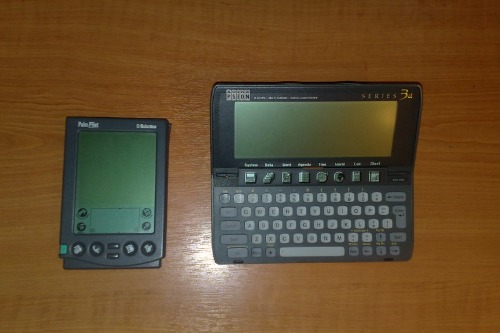
Long before the iPhone, Palm made handheld devices that felt futuristic. The PalmPilot and later the Treo smartphone were beloved by professionals in the late 1990s and early 2000s. But Palm struggled to evolve its operating system fast enough as Apple and Android redefined the market. By 2010, it was acquired by HP, which quickly discontinued its products.
Palm’s WebOS was praised for innovation but poorly marketed. Despite that, its DNA lives on—many of its design ideas influenced modern mobile interfaces. In 2018, a tiny “Palm” phone made a brief comeback, but it barely made a dent. Still, for anyone who owned a stylus-equipped PDA, Palm represents a fascinating chapter in tech evolution.
8. Compaq
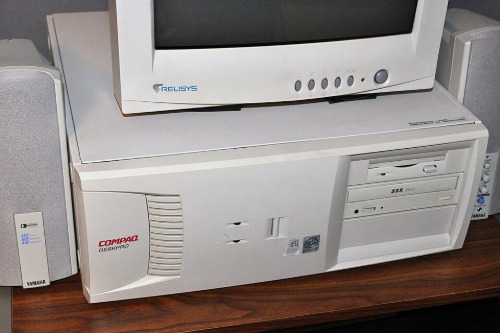
Compaq was once a titan in personal computing. Founded in 1982, it became the largest PC supplier in the world by the late 1990s. Known for its portable computers and compatibility with IBM PCs, it helped bring affordable computing to homes and offices. But intense price competition and brand confusion eroded its market share.
In 2002, HP acquired Compaq in a controversial $25 billion merger that ultimately diluted both brands. The name lingered for a while but was officially retired in 2013. Compaq’s story is one of ambition and consolidation—a victim of the industry’s relentless pace. Few remember it today, but its influence is embedded in the laptops we use now.
9. Napster
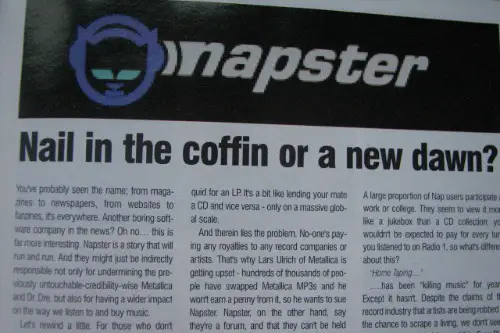
Napster didn’t sell a product—it sparked a revolution. Launched in 1999, it made peer-to-peer music sharing mainstream, upending the entire music industry. Lawsuits from major record labels and Metallica led to its shutdown in 2001, but the idea of digital music was out of the bottle. In many ways, it paved the path for Spotify and Apple Music.
The brand has lived several lives since, reemerging as a legal streaming service under new ownership. But most people remember it as the rebellious upstart that changed how we listen to music forever. Napster made downloading songs exciting, illegal, and addictive all at once. It’s a perfect example of how disruption can’t always be contained.
10. Yahoo!
In the early internet age, Yahoo! was the homepage. It offered email, news, search, and even its own directory of websites—basically a proto-version of Google. But while it started strong, Yahoo! failed to focus its vision and missed major acquisition opportunities, including a chance to buy Google itself. By the late 2000s, it had become a patchwork of outdated services.
After multiple CEO shake-ups and a massive data breach, Yahoo! was sold to Verizon in 2017. The brand still exists but carries none of its former influence. It’s now mostly a nostalgia piece for anyone who remembers early dial-up browsing. Yahoo!’s rise and fall show how quickly internet giants can become footnotes.
11. Sears

For over a century, Sears was synonymous with American retail. Its catalog helped define consumer culture, selling everything from tools to houses by mail. But as the digital age dawned, Sears failed to modernize its stores or online presence. Decades of underinvestment and poor management left it unable to compete with Amazon and Walmart.
After filing for bankruptcy in 2018, Sears closed most of its stores and became a shell of its former self. At one point, it was America’s largest employer—now it’s mostly a memory. The few remaining locations feel like ghosts of a golden retail past. Sears’ story is both classic and tragic: adapt or disappear.
12. Blockbuster
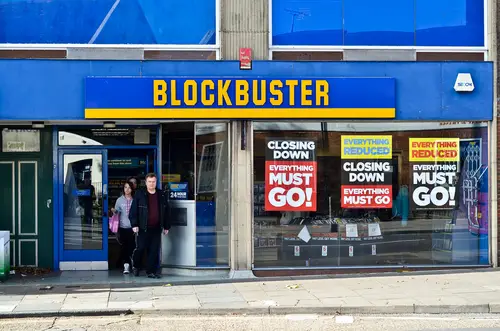
Once the ultimate weekend destination, Blockbuster reigned supreme in home entertainment during the 1990s and early 2000s. At its peak, it operated over 9,000 stores worldwide and practically defined movie night. But the rise of Netflix and on-demand streaming left Blockbuster unable to adapt quickly enough. By 2010, it filed for bankruptcy, and today, just one store in Bend, Oregon remains—a nostalgic relic of a bygone era.
What’s wild is that Netflix once offered to sell itself to Blockbuster for $50 million in 2000, and Blockbuster declined. That one decision is now legend among business missteps. The company tried pivoting to mail rentals and online services too late to matter. Still, for anyone who remembers the smell of popcorn and plastic cases, Blockbuster will always be more than just a failed business.
13. BlackBerry
There was a time when every executive had a BlackBerry clipped to their belt. Known for its secure email and tactile keyboard, it dominated the smartphone market in the 2000s. But after the iPhone’s debut, BlackBerry failed to pivot to touchscreens and apps. Within a few years, its market share evaporated almost completely.
The company officially stopped making phones in 2022, focusing instead on cybersecurity software. For a while, though, it was the ultimate status symbol—“CrackBerry” wasn’t just a joke. Even Barack Obama was famously reluctant to give his up. BlackBerry’s fall is a master class in how innovation can turn on you overnight.
14. Kodak
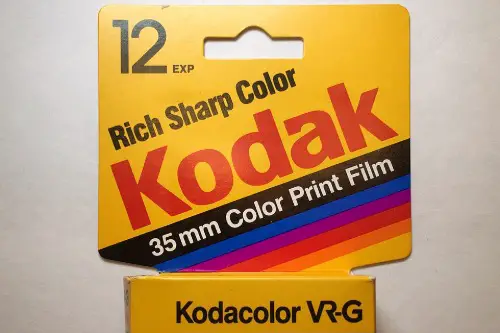
Kodak once was photography. For decades, it led the market in film and cameras, even inventing the first digital camera back in 1975. Ironically, that innovation contributed to its downfall, as Kodak failed to embrace digital photography fast enough. By 2012, the company filed for bankruptcy after years of decline.
Kodak has since reinvented itself in niche imaging and printing sectors, but the brand’s golden age is long gone. Its name still carries weight, though, especially for anyone who remembers film canisters and photo labs. The company’s story has become a business-school parable about fearing disruption. In the end, Kodak captured the moment—but missed the future.
15. Netscape
In the 1990s, Netscape Navigator was the browser that defined the early web experience. Before Chrome or Safari, it was how millions first explored the internet’s wild frontier. Its 1995 IPO helped ignite the dot-com boom, making it one of the decade’s most valuable startups. But when Microsoft bundled Internet Explorer with Windows, Netscape’s dominance quickly evaporated.
The company was bought by AOL in 1999 and gradually faded from relevance. Its underlying technology, however, helped shape Mozilla Firefox, ensuring Netscape’s DNA lived on. Today, few remember just how revolutionary it once felt to “surf the web” with that big blue “N” logo. Netscape’s fall remains a classic example of how quickly software empires can crumble.
16. Pan Am
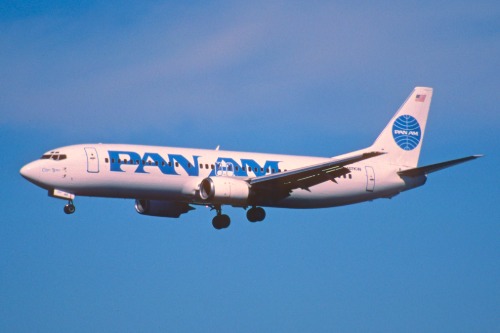
Pan American World Airways wasn’t just an airline—it was an icon of American glamour and global ambition. Founded in 1927, it pioneered international routes, luxury air travel, and even the jet age itself. Its blue globe logo symbolized sophistication, adventure, and innovation. But a mix of rising fuel costs, terrorism fears, and deregulation eroded its dominance.
By 1991, Pan Am filed for bankruptcy, leaving behind a romanticized legacy of the golden age of flight. For decades, its name appeared in movies and advertising as a symbol of American reach. Attempts to revive the brand have come and gone, never capturing its former prestige. Today, Pan Am exists mostly as nostalgia for a time when flying still felt extraordinary.
17. Enron

At the turn of the millennium, Enron was hailed as one of America’s most innovative companies. It transformed from a regional energy supplier into a trading giant, boasting cutting-edge financial strategies. But behind the scenes, its profits were built on fraud, deception, and creative accounting. When the truth emerged in 2001, Enron collapsed almost overnight.
The scandal wiped out billions in investments and cost thousands their jobs and pensions. It led to sweeping reforms like the Sarbanes-Oxley Act, changing how corporations are audited and held accountable. Enron’s name became shorthand for corporate greed and corruption. Today, it’s barely remembered by younger generations—but its shadow still looms over business ethics.
18. Woolworth’s
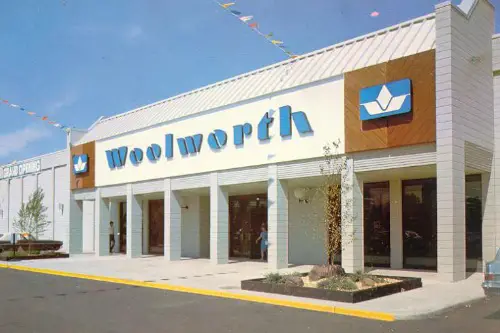
For most of the 20th century, Woolworth’s was the “five-and-dime” store at the heart of Main Street America. It sold everything from candy to housewares and pioneered the modern retail chain concept. Its lunch counters were iconic community hubs—and, in the 1960s, even became landmarks of the civil rights movement. But discount giants like Walmart and Target eventually made its model obsolete.
The last U.S. Woolworth’s closed in 1997, marking the end of an era in American shopping. The company’s international spin-offs lived on for a time, but the name gradually disappeared. For many, Woolworth’s evokes a simpler, more personal retail experience. It’s a reminder of when variety stores were social spaces as much as shopping destinations.
19. Gateway
Gateway made computers feel personal in a different way—right down to its signature cow-spotted boxes. Founded in the 1980s, it became one of the top PC makers during the home-computing boom of the 1990s. Its direct-to-consumer model and quirky branding stood out in a crowded market. But as Dell and HP streamlined production, Gateway struggled to keep up.
The company was acquired by Acer in 2007, effectively ending its independent run. Its once-familiar logo disappeared from store shelves as quickly as it had risen. Many early internet users fondly recall their first Gateway desktop or laptop. Yet today, it’s another forgotten name in the long list of fallen PC pioneers.
20. Friendster
Before Facebook, Twitter, or Instagram, there was Friendster—the first real social network for millions. Launched in 2002, it let users create profiles, connect with friends, and share interests in a way that felt new and exciting. Its early growth was explosive, but frequent crashes and slow performance drove users away. MySpace and Facebook quickly swooped in to fill the gap.
Friendster tried reinventing itself as a gaming platform but never regained momentum. By 2011, it shut down completely, its user base already absorbed by newer networks. Still, it laid much of the groundwork for the social web that followed. Friendster may be forgotten, but its DNA runs through every app that came after.
21. Tower Records
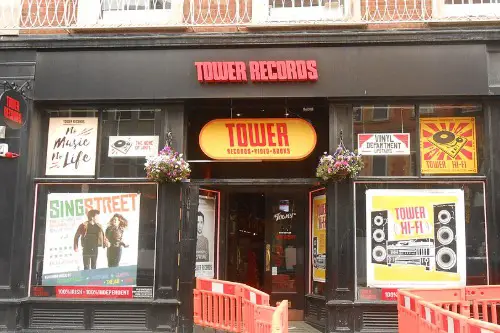
For music lovers, Tower Records was more than a store—it was a cultural institution. Founded in Sacramento in 1960, it grew into a global chain where fans could browse endless rows of CDs, vinyl, and tapes. Each store was a hangout for collectors, musicians, and curious teenagers alike. But as digital downloads and streaming rose, physical media sales plummeted.
By 2006, Tower Records filed for bankruptcy and closed all of its U.S. locations. The loss felt personal for generations who associated the brand with discovery and community. Though the name was briefly revived as an online retailer, it never regained its old soul. Today, Tower Records lives on mostly in memory, a symbol of the pre-digital music era.
This post 21 Once-Prominent Companies That Americans Barely Remember was first published on American Charm.

