
1. The Neon Museum (Las Vegas, Nevada)
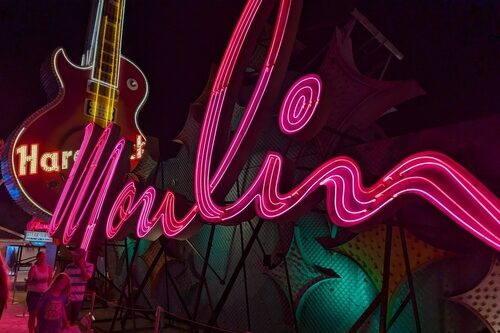
On the edge of downtown Las Vegas, the Neon Museum preserves retired signs from old casinos and businesses. Founded in 1996, the museum’s “Neon Boneyard” holds restored and unrestored pieces from landmarks like the Stardust and the Moulin Rouge. The collection includes signs dating back to the 1930s. At night, some are lit again, glowing against the desert sky.
I included it because it’s a curated graveyard of America’s flashiest roadside promises. Las Vegas built its identity on spectacle, and these signs are its fossils. Rather than demolishing the past entirely, the city chose to archive parts of it here. Wandering among them feels like paging through a luminous scrapbook of American excess.
2. Salvation Mountain (Niland, California)
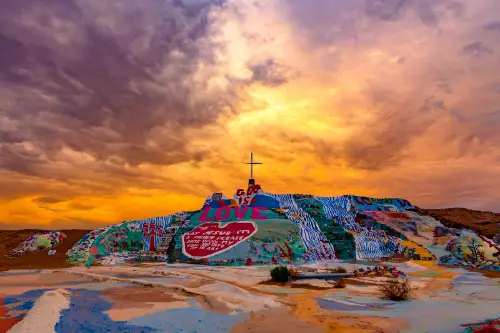
Out near the southeastern edge of the Salton Sea, Salvation Mountain looks like something willed into existence by sheer stubborn devotion. Created by Leonard Knight over decades, the technicolor hill is made of adobe clay and layers of donated paint. Bible verses and bright flowers cover the surface in looping, handmade lettering. It feels less like a roadside attraction and more like a personal testament that just happens to be visible from the highway.
I included it because it captures a very specific American strain of outsider art and spiritual individualism. This isn’t a polished installation; it’s a one-man project that became a pilgrimage site. The textures crack under the desert sun, and the colors fade and get repainted, so it’s always in a state of change. Standing there, you’re reminded that the open road has long made room for big, eccentric dreams.
3. Cadillac Ranch (Amarillo, Texas)
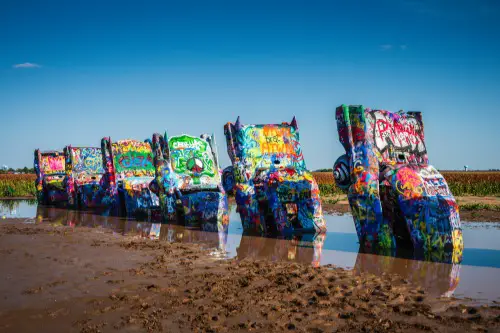
Just off Interstate 40 west of Amarillo, Cadillac Ranch rises out of a field like a row of tailfins diving into the earth. Installed in 1974 by the art collective Ant Farm, it features ten Cadillacs buried nose-down at the same angle as the Great Pyramid of Giza. The cars date from 1949 to 1963, charting the evolution of the Cadillac tailfin. Layers of spray paint coat them so thickly that the metal underneath feels almost fossilized.
It makes the list because it perfectly blends Route 66 nostalgia with participatory art. Visitors are encouraged to bring their own spray paint and leave a mark, so the surface changes daily. The cars have been repainted and even relocated slightly over the years due to development, but the spirit remains the same. It’s a relic not because it’s frozen in time, but because it keeps collecting time in neon layers.
4. The Wigwam Motel (Holbrook, Arizona)
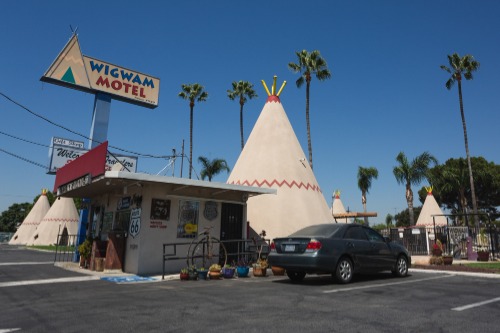
Along old Route 66 in Holbrook, the Wigwam Motel offers rooms shaped like concrete teepees. Built in 1950 by Chester E. Lewis as part of a small chain, it’s one of the few surviving Wigwam Villages. Each “wigwam” is a standalone unit, with classic cars often parked outside for that extra mid-century touch. The neon sign out front glows at night like a postcard from another era.
I included it because it embodies the playful architecture that once defined roadside travel. This was a time when motels competed through novelty as much as comfort. The rooms have been updated for modern guests, but the exterior remains delightfully retro. Staying there feels like sleeping inside a piece of Route 66 folklore.
5. The Corn Palace (Mitchell, South Dakota)
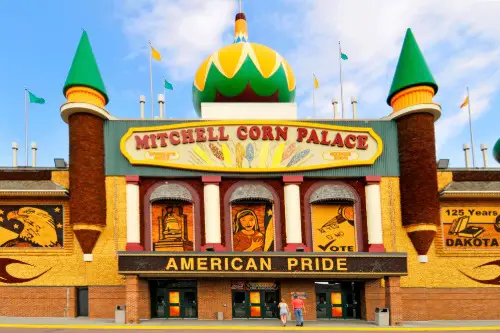
Right in downtown Mitchell stands the Corn Palace, officially known as the World’s Only Corn Palace. First established in 1892 to showcase the region’s agricultural bounty, the building is redecorated each year with new murals made from corn and other grains. The exterior panels form large-scale images crafted from different colors of natural corn. It’s part civic center, part folk art experiment.
It makes the list because it reflects a distinctly American pride in local industry and abundance. Few places lean so wholeheartedly into their crop of choice. The fact that the murals are temporary and rebuilt annually gives it a ritualistic quality. You’re not just seeing a building; you’re seeing a tradition that’s been renewed for well over a century.
6. South of the Border (Hamer, South Carolina)
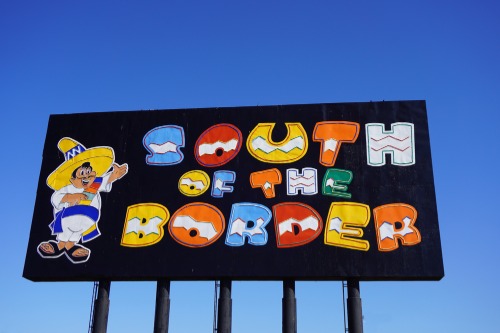
Just off Interstate 95 near the North Carolina line, South of the Border greets drivers with a giant sombrero-shaped observation tower. Opened in 1950 by Alan Schafer, it began as a beer stand capitalizing on differences in state liquor laws. Over time it grew into a sprawling complex of restaurants, shops, a motel, and a reptile lagoon. Its mascot, Pedro, appears on hundreds of billboards up and down the East Coast.
It belongs on this list because it’s a monument to mid-century roadside kitsch and aggressive advertising. The puns on its billboards are intentionally groan-worthy and impossible to ignore. While some aspects reflect outdated stereotypes, the site remains a fascinating snapshot of 1950s marketing bravado. Driving up to it feels like arriving at a relic of peak highway excess.
7. The Blue Whale of Catoosa (Catoosa, Oklahoma)
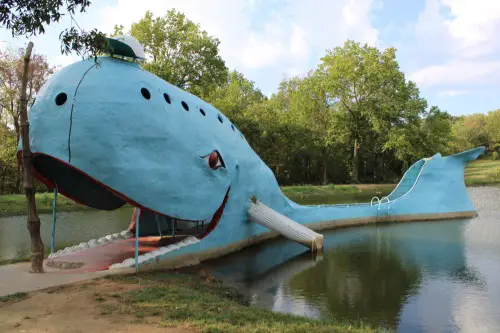
Along Route 66 in Catoosa, a giant smiling blue whale rises from a small pond. Built in the early 1970s by Hugh Davis as an anniversary gift to his wife, it became a local swimming spot and roadside attraction. The whale features a slide and a small deck area inside its belly. Though swimming is no longer allowed, the structure still draws visitors for photos.
I included it because it represents the personal, handmade side of roadside Americana. This wasn’t a corporate installation but a husband’s quirky project that grew into a community landmark. Its faded paint and gentle grin feel charming rather than slick. It’s a reminder that not every relic was built for profit; some were built out of love.
8. The Cabazon Dinosaurs (Cabazon, California)
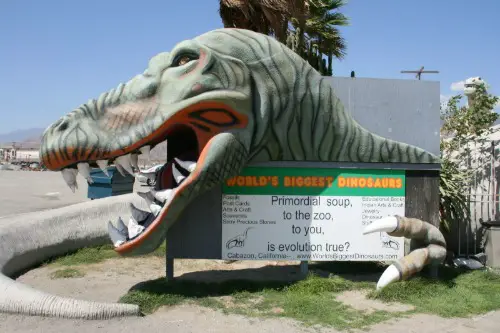
Towering beside Interstate 10 near Palm Springs, the Cabazon Dinosaurs are hard to miss. The 150-foot-long Brontosaurus and 65-foot-tall Tyrannosaurus rex were constructed in the 1960s and 1980s by sculptor Claude Bell. Originally intended to draw customers to his Wheel Inn restaurant, they became icons in their own right. You can even climb inside the T. rex for views from its mouth.
They make the list because they capture the era when bigger automatically meant better. These concrete giants predate today’s slick theme parks and feel charmingly handmade. Their presence in films and commercials has cemented them in pop culture memory. Pulling off the freeway to stand at their feet feels like meeting prehistoric guardians of the asphalt.
9. Lucy the Elephant (Margate City, New Jersey)

In Margate City, just south of Atlantic City, a six-story elephant named Lucy has been watching the shoreline since 1881. Built by James V. Lafferty as a real estate promotion, Lucy was meant to attract buyers to the area. Over the years she has served as an office, a tavern, and even a summer home. Today she’s a National Historic Landmark and offers tours inside her wooden-and-tin frame.
She earns her spot because she predates the automobile era yet fits perfectly into road trip lore. Lucy is one of the oldest surviving examples of novelty architecture in the United States. Her survival required community fundraising and restoration efforts in the 1970s. Seeing her up close feels like discovering a Victorian-era dream that refused to collapse.
10. The Enchanted Highway (Regent, North Dakota)
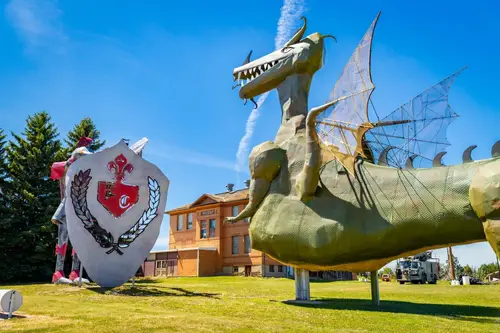
Stretching along a 32-mile road between Interstate 94 and Regent, the Enchanted Highway features a series of massive scrap-metal sculptures. Created by local artist Gary Greff beginning in 1989, the installations include towering grasshoppers, giant pheasants, and a family of deer. Many of them hold records for being among the largest metal sculptures in the world. The highway was conceived as a way to draw visitors to a struggling rural town.
It belongs here because it shows how communities reinvent themselves through art. Each sculpture rises unexpectedly from the prairie, breaking up long stretches of open road. The project reflects late-20th-century efforts to revive small-town America through creativity. Driving that route feels like passing through a gallery designed for pickup trucks and big skies.
11. Wall Drug (Wall, South Dakota)
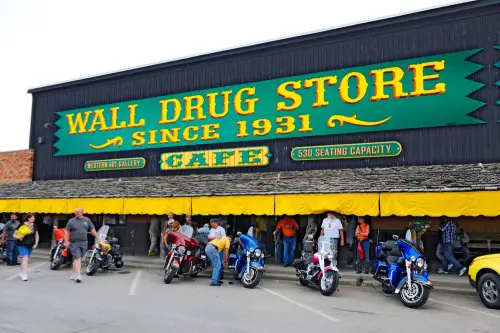
Billboards for Wall Drug start hundreds of miles before you reach the tiny town of Wall, promising free ice water and 5-cent coffee. Founded in 1931 by Ted and Dorothy Hustead, it began as a struggling pharmacy during the Great Depression. The offer of free ice water to lure in travelers worked so well that the store expanded into a sprawling roadside complex. Today it includes a restaurant, souvenir shops, and a giant jackalope statue that practically demands a photo.
It earns its place here because it’s a living artifact of classic highway marketing. The hand-painted-style signs lining the interstate feel like a time capsule from mid-20th-century road culture. Even though it’s grown into a massive operation, the core pitch hasn’t changed much. Walking through its maze of Western-themed rooms feels like stepping into a preserved chapter of Americana.
This post Road Trip Stops That Feel Like Relics was first published on American Charm.

